Phyllosphere
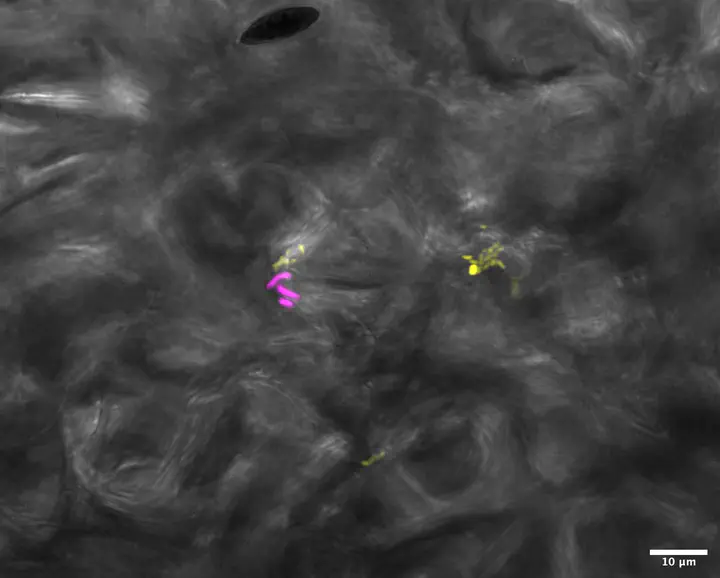
The aerial parts of plants –leaves, stems, flowers– are considered as the phyllosphere. This environment is oligotrophic and heterogeneous for microbes to live on. Resources are limited and unevenly distributed. Thus, different possibilities would explain : (1) competition is high and bacteria have low degree of resource overlap between them to allow coexistence (increased niche stabilisation); (2) competition is low and bacteria are metabolically dependent on each other or on certain taxa; (3) they associate randomly and can tolerate each other without impacting on each other’s population growth. These are questions I tried to tackle during my PhD and certainly am still interested in answering.
Using Arabidopsis thaliana as a host model, I’m using synthetic bacterial communities to understand the spatial patterns between bacterial taxa (mainly between Sphingomonas and Methylobacteria) and factors that affect their interactions in the phyllosphere.
During my PhD, I looked at the distribution patterns of bacteria between and/or within the genera Sphingomonas and Methylobacteria. These groups are phylogenetically related at the class level and metabolically distinct. So far, coexistence and aggregation is a common feature of bacterial distribution in pairwise comparisons.
Also, using the CUSPER bioreporter –which reports on the life history of an immigrant population in a new environment–, I looked at the effect of a diverse group of bacteria in the fitness of a focal population of Pantoea eucalypti 299R. More of that in our pre-print!.